The Holes That Remember: Rebuilding Britain's Vanished Timber Circles
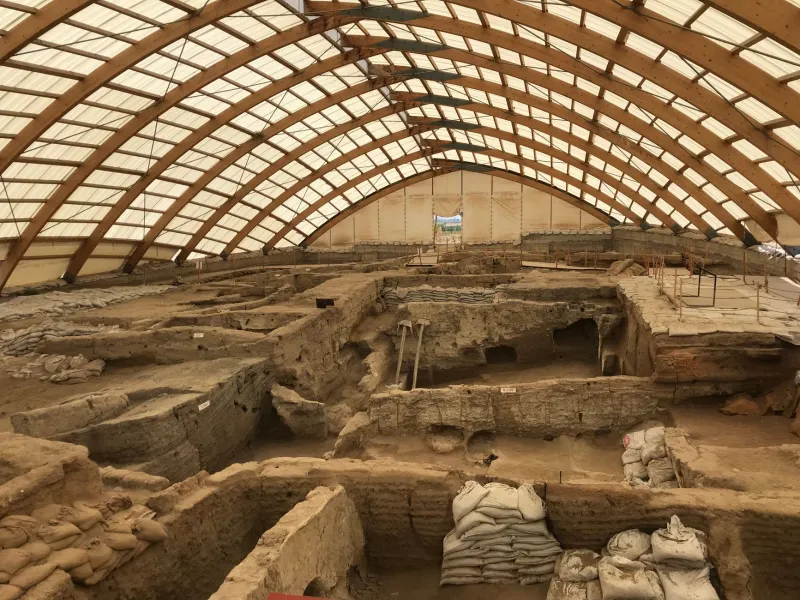
You can stand in the middle of a timber circle and see, on a good day, a few darker patches in the turf. That is it. No uprights, no roof, no handy interpretive panel with a cutaway drawing. Just a field, a faint geometry, and a lot of questions.
And yet these are some of the most important monuments in prehistoric Britain. Before Stonehenge's sarsens went up, people were already building in wood: great rings of oak posts, sometimes hundreds of them, sometimes arranged in concentric circuits like a wooden Stonehenge. That is the magic trick at the heart of the subject. The wood has gone. The circle has not.
What actually survives a few thousand years
Timber rots. In most British soils it disappears completely, which is why a timber circle looks like an absence rather than an object. What archaeologists find is the negative imprint of construction: a pit dug for a post, packing stones wedged around its base, and a darker fill where the timber itself once stood or decayed. Sometimes there is a post pipe, the void left when a trunk is pulled out or burns away, later filled with sediment. Sometimes there are stakeholes, shallow sockets for slender uprights that may have held fencing, screens, or nothing more exciting than markers.
Preservation is wildly uneven. On chalk, the stains can be crisp: a dark fill against pale bedrock. On sands and gravels they blur into the background. In acidic soils, bone and antler vanish too, leaving only flint and fired clay to date. Waterlogged sites are the exception. Seahenge at Holme-next-the-Sea, exposed in 1998, preserved an upturned oak stump surrounded by a ring of split timbers, a Bronze Age structure that would otherwise have been a smudge in the mud. It is also a reminder of how rare those conditions are, and how quickly they can change.
From stain to structure
Reading a ring is part archaeology, part geometry, and part guesswork with error bars. The basics are measurable: the diameter of the ring, the number of posts, the spacing between them, the depth and profile of each pit. A tight circuit of slender stakes says something different from a ring of hefty posts set a metre apart. Entrances, alignments, and gaps in the sequence all get plotted, and the plan starts to look less like a random scatter and more like a designed space.
Then there is dating. Radiocarbon on charred post fragments, antler picks, or carbonised residues from the pits; tree-ring sequences where oak survives; Bayesian statistical models that tighten the chronology by combining many dates with stratigraphy. At some sites the results suggest the posts went up over decades or centuries, replaced one by one. A timber circle was not necessarily built once and left alone. It was maintained.
Geophysics helps map the invisible. Magnetometry picks up burnt features and pits; resistivity can trace ditches and compacted surfaces; ground-penetrating radar slices through the soil in three dimensions. Aerial photography in a dry summer still does some of the best work, revealing cropmarks where buried features have starved the roots of moisture. LiDAR is wonderful for earthworks, less so for a posthole half a metre across. None of it tells you what the posts looked like above ground.
The roof question
Here is where the arguments get enjoyable. Were timber circles roofed halls, open-air enclosures, or something in between?
The case for roofs rests on scale and engineering. Some rings have posts large enough to carry a substantial load, and a few have central posts that could have supported a ridge. Experimental builds at places such as Butser Ancient Farm have shown that a ring of oak can hold up a conical roof without iron nails, using only joints, pegs, and gravity. It is hard work, but it is possible.
The case against is just as robust. Big posts do not prove a roof; they prove people wanted big posts. Many timber circles have no convincing floor deposits, no hearths in the middle, no drip gullies, and no daub. If you had built a roofed building, you would expect some of those to survive. What you often find instead is a ring of pits stuffed with deliberately placed things: Grooved Ware pottery, pig and cattle bone, flint tools, chalk objects, occasionally human remains.
That pattern points towards ceremony, feasting, and deposition, and towards the posts themselves as the point. A post is a statement. Taking it down, burning it, or burying something at its base is also a statement. Archaeologists call this structured deposition, which is a tidy phrase for a messy human habit: putting important things in important places and then walking away.
Reconstructions are arguments, not answers
Visit a rebuilt timber circle and you will see a confident structure. That confidence is borrowed. Every reconstruction is a series of decisions: roof or no roof, wall or no wall, raised floor or bare earth, one entrance or four. Each choice is defensible; together they add up to a hypothesis you can walk around.
That is not a criticism. It is the point. A good reconstruction makes the debate visible. It also reminds visitors how strange the original would have felt: a dark, breathing, creosote-smelling interior, or an open ring of towering posts with the sky wheeling overhead. We do not know which. We know it mattered enough to build.
Why the holes are running out of time
Postholes are fragile in a way that stone is not. Ploughing shaves them thinner year by year. Development can remove them in an afternoon. Drought cracks the ground and lets oxygen in; heavy rain washes fills away. A ring that was legible in the 1950s may now be a scatter of ambiguous smudges.
That is why recording matters, and why the UK's Historic Environment Record system exists. It is also why scheduled monument status and planning archaeology, however unfashionable to grumble about, do a lot of quiet work. If you think you have found a ring of pits in a field, the right move is not to dig. Photograph it, note the location, and contact your local authority's archaeological officer or the Portable Antiquities Scheme's Finds Liaison Officer. Context is everything; a hole without its surroundings is just a hole.
Seeing what is not there
The best timber circle explanations do not pretend the evidence is tidier than it is. They give you a structure, a date range, a set of possibilities, and a clear sense of which bits are load-bearing and which are decoration.
Stand in that field again. The posts are gone, the roof is gone, the people are gone. What remains is a pattern of stains, the negative space of a building. Learning to read it is the closest thing archaeology has to pulling a rabbit out of a hat. The rabbit does not come back. But you can see exactly where it sat.