The Emperor’s Face Is Only the Beginning: Reading Roman Coins Found in Britain
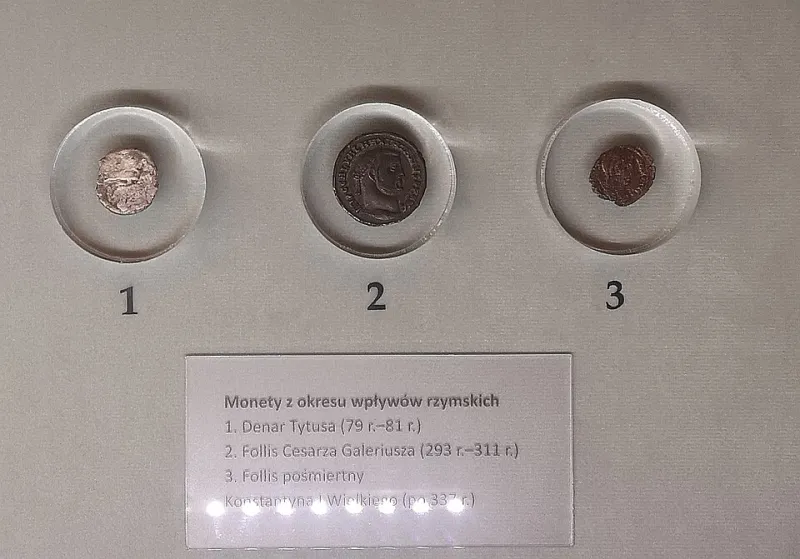
Photo: Silar, CC BY-SA 4.0, via Wikimedia Commons
A Roman coin in a museum case can look like a tiny press release from the ancient world. Emperor’s face on the front, grand titles around the edge, maybe a god or a gate on the back. It is tempting to read the whole of Roman Britain from it: who was in charge, when they arrived, what everyone believed, and why it all fell apart.
If only. Coins are brilliant evidence, but they are not tidy little fact sheets. They were made, lost, clipped, copied, buried and dug up by people with their own reasons. At Ancient News, we like a good Roman headline as much as anyone — but the humble coin deserves a more careful reading.
A coin is not a date stamp
The first myth to retire is the idea that a coin dates the layer it came from to the exact year on its face. It does not. A coin gives you a terminus post quem: the earliest possible date for whatever it was found with. A coin of Claudius in a ditch does not mean the ditch was dug in AD 43, or that Claudius himself popped over for a site visit. It means the ditch was probably dug after that coin was minted — and the coin could have been lost decades later.
Context is everything. A coin from a carefully excavated floor surface, sealed under a collapsed wall, is one thing. A corroded coin from a ploughsoil field is another. The Portable Antiquities Scheme has transformed what we know about finds in England and Wales, but a findspot recorded from a detector signal is not the same as a coin lifted from a stratified deposit with a soil sample and a plan drawing.
The emperor is doing propaganda, not journalism
Roman coin designs were messages, but they were not news bulletins. The face and legend advertised imperial power to soldiers, officials, traders and provincial elites. Types could celebrate victories, announce consulships, honour ancestors or promise plenty. They tell us what someone wanted people to think, not necessarily what everyone did think.
In Britain, coins circulated in a world of local identities, army supply, town life and rural communities. A coin with an emperor’s face does not automatically mean the person who lost it was loyal, Romanised or even literate. It means they had access to a coin. That is a smaller, more human claim — and usually a more interesting one.
Wear, clipping and the trust problem
Look past the portrait. How worn is the surface? A heavily smoothed coin may have passed through many hands. A sharp, barely circulated coin may have been lost soon after minting, or kept as savings. Wear is not a perfect clock, but it is a clue.
Then there is clipping. Late Roman silver siliquae are famous for it: people shaved slivers from the edges, reducing the coin while still passing it off at face value. This is not just ancient petty crime. It is evidence of anxiety about bullion, trust and supply. If people are trimming coins, they are responding to a system under strain — or simply to the temptation of a little extra silver.
Counterfeits tell a similar story. Plated denarii, base-metal copies and so-called barbarous radiates show that coinage was not a clean, top-down system. Copies could be made to fill gaps in small change, to deceive, or both. A fake coin in a museum drawer is not just a failure of Roman quality control. It is a sign of demand, local initiative and the messy reality of trust in everyday exchange.
Hoards are not time capsules
Britain is famous for Roman coin hoards, and it is easy to treat them as buried bank accounts with a neat date of deposit. Some probably were savings hidden in a hurry. Others may have been votive deposits, scrap collections, or accidental losses. A hoard’s latest coin gives a rough date for burial, but it cannot tell you why the owner never came back.
That matters when coins are used to tell big stories about invasion and collapse. A hoard does not prove that Roman Britain ended on a particular Tuesday. It shows that someone, or several someones, put metal in the ground. The reasons could be economic, religious, military or deeply personal. We should not flatten that into a single national narrative.
What numismatics can actually do
None of this means coins are useless. Far from it. Numismatics — the study of coins — can trace supply routes, mint activity and the movement of people and goods. It can show where small change was scarce and where copies filled the gap. It can help date stratified deposits, and it can reveal how imperial imagery was adapted, imitated and ignored.
Coins also let us ask better questions. Why does this site have so many late Roman coins and so few early ones? Why are siliquae clipped here but not there? What does a scatter of copies tell us about local markets? These are not tidy headlines, but they are real evidence.
If you find one in a British field
Practical advice first: slow down. Record the findspot as precisely as you can, photograph the coin where it lies if possible, and resist the urge to scrub it. Cleaning can remove the very surface detail that specialists need. Note the depth, the soil and any nearby features.
Report the find to your local Finds Liaison Officer and record it with the Portable Antiquities Scheme. Check the current Treasure Act rules with them as well; single coins are often not Treasure, but hoards and certain assemblages may be. The point is not to turn every find into a museum piece. It is to make sure the information survives even if the object ends up in a private collection.
If you see one in a museum
Read the label, then read the coin. Look for the mint, the denomination, the date and the findspot. Compare the obverse and reverse — the reverse often carries the more interesting message. Check the edge for clipping and the surface for plating or copying. Ask what the display is not telling you: was this a single find, a hoard, a stray loss or a curated collection?
Roman coins are small change, but they are asked to carry big claims. They cannot give us a neat story of invasion, trade and collapse with a bow on top. What they can give us is better: a clipped edge, a copied face, a worn portrait, a lost purse. That is not a press release from the emperor. It is a trace of someone’s ordinary day.