The Interpreter in the Room: Roman Britain’s Messy, Multilingual Reality
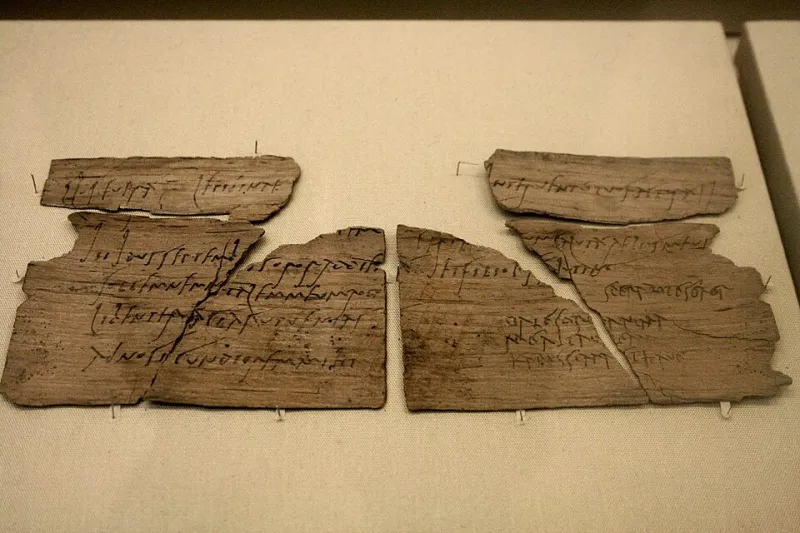
Photo: Unknown, CC BY-SA 3.0, via Wikimedia Commons
Ask a British pub quiz what language the Romans spoke in Britain and someone will say Latin. Ask what the Britons spoke and someone else will say Celtic. Both answers are true enough to get the point, and both are too tidy to be the whole story. Roman Britain was not a bilingual island with two neat columns. It was a province full of accents, half-learned phrases, professional go-betweens and people who probably never said a word of Latin in their lives.
A province of switchboards, not language exams
Language contact is rarely a matter of one side issuing orders and the other side nodding. It is a switchboard: soldiers from Gaul and the Rhineland, traders from the Mediterranean, auxiliary units recruited far from home, local elites chasing Roman citizenship, slaves, merchants, tax collectors and farmers all plugging into each other when they had to. Latin was the language of power, paperwork and the army. Brittonic was the language of most households, fields and markets. But between those poles sat the people who made the system work: interpreters, bilingual traders, army go-betweens and local grandees who could move between worlds.
Some of those people leave no names. That is the point. The Roman Empire did not run on everyone suddenly becoming fluent. It ran on enough people being fluent in the right places, and on a lot of everyone else improvising.
What the writing actually shows
Most of our evidence comes from writing, which immediately tilts the picture. The Vindolanda tablets, near Hadrian’s Wall, give us letters, lists and invitations from around AD 100. They are vivid, human and almost entirely in Latin. People ask for beer, complain about shortages, invite each other to dinner and generally sound like they are getting on with life. It is tempting to read that as evidence that Roman Britain was chatty in Latin. It is better read as evidence that a certain military and civilian network conducted its business in Latin.
The Bloomberg tablets from London, dating to the decades after the invasion of AD 43, show similar administrative and commercial Latin. The curse tablets from Bath and Uley are another kind of evidence: ritual language, often written by or for people asking a god to sort out a theft. These are not transcripts of the street. They are formal, formulaic and mediated. A curse tablet can tell us that Latin was used to talk to a deity; it cannot tell us what the person who lost the cloak said when they found it gone.
Graffiti are more interesting because they are scruffier. They show spelling mistakes, abbreviations and casual marks — evidence that Latin was not only a language of marble and officialdom. But even graffiti are written by people who could write. The vast majority of Roman Britain’s population left no words at all. They are the invisible majority, and any honest account has to admit they are mostly silent.
The invisible middlemen
The word interpres turns up in Roman contexts for an interpreter or go-between. We should not imagine a professional civil-service language corps in Britain, with lanyards and a training programme. The reality was probably more ad hoc: slaves, freedmen, traders and soldiers who picked up enough of another language to bargain, complain or negotiate. A fort commander dealing with a local chieftain needed someone. A merchant selling wine to a British farmstead needed someone. A tax collector definitely needed someone.
You can see the logic in the archaeology of mobility. The Roman army in Britain was not a legion of Italians. It drew auxiliaries from across the empire, people who arrived speaking their own languages and learned Latin as a lingua franca. That alone makes a simple Latin-versus-Celtic model wobble. The army was a multilingual workplace before it was anything else.
Local elites had their own reasons to learn Latin. It was the language of law, citizenship, display and getting on. A British grandee who put up a Latin inscription was not necessarily abandoning the language of home. They were performing membership in a wider world, much as people today switch between a local dialect and a formal register depending on who is watching.
Loanwords and place names: the long shadow
Latin did not vanish from Britain when the legions left. It left traces in Brittonic, the ancestor of Welsh, Cornish and Breton. Words for church, bridge, window and a fair few everyday items were borrowed from Latin. That tells us contact was deep and long-running, not a single conversation at a fort gate. It does not tell us that everyone was bilingual. Borrowing happens when people need a word for something new, or when a prestige language supplies a useful term. It is evidence of contact, not a census.
Place names are similar. The English -chester and -caster come from Latin castra, a fort. Colchester, Winchester, Manchester and Lancaster all carry the imprint of Roman military vocabulary. But place names are often administrative labels, not snapshots of household speech. They show what stuck in the landscape and in later mouths, not what a shepherd in the hills called the field.
Why the tidy picture survives
The tidy picture survives because it is easy to tell. Romans arrive, Romans speak Latin, Britons learn Latin or resist it, and then the Romans leave. That story has heroes, villains and a clean ending. The evidence gives us something messier: a patchwork of local arrangements, professional intermediaries and uneven access. Some people were fluent. Some could haggle. Some could recite a prayer in Latin without understanding it. Some never needed it at all.
None of this makes Roman Britain a happy multicultural paradise. Language contact happens under power. Latin was the language of the conqueror, the tax office and the camp. But power does not make people fluent overnight, and it does not erase the people in the middle who did the translating. If we want to hear Roman Britain, we should listen less for a single voice and more for the hubbub of a market where several languages are being mangled into a deal.