The Compost of Empire: Why Roman Britain’s ‘Dark Earth’ Is a Process, Not a Curtain Call
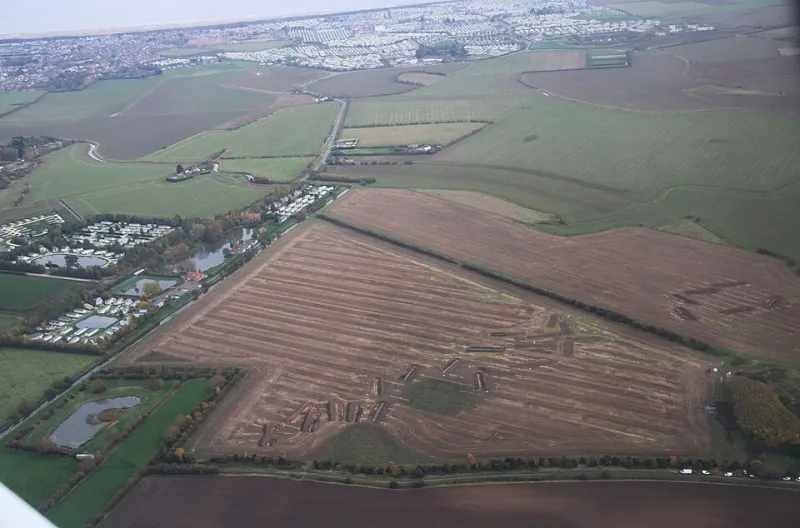
Photo: Chris , CC BY-SA 2.0, via Wikimedia Commons
Few archaeological labels work as hard as ‘dark earth’. It sounds like a period, a verdict, a line on a museum panel: the Romans left, the lights went out, and a dark layer crept over the tessellated floors. In Britain, that layer is real enough. The story often pinned to it is not.
At sites such as Silchester, London, Cirencester and Wroxeter, excavators have long encountered thick, dark, organic-rich deposits sitting above Roman buildings and streets. In the past, these layers were handy shorthand for abandonment. Today, many archaeologists see them as something far more awkward: a record of accumulation, decay, dumping, digging, ploughing and all the ordinary mess that happens when a town stops being maintained in one way and starts being used in another.
A label doing too much work
The phrase ‘dark earth’ describes a deposit, not a date. It can be dark because it is full of decomposed organic matter, charcoal, ash, manure, rotten timber, thatch, plant roots and humic material. It can be thick because rubbish piled up, because floors were left to silt, because buildings collapsed, because gardens and allotments were dug into ruins, or because later ploughs churned everything together. Sometimes all of the above happened, century after century, in the same few metres of soil.
That is why the label is a bit of a trap. A dark earth layer can look dramatic in section — a rich black band cutting across the clean lines of Roman stratigraphy — but it does not come with a built-in explanation. It is an archaeological unit, not a historical headline.
What actually goes into the stuff
Dark earth is best understood as a rubbish heap with a memory. It may contain pottery, animal bone, charred grain, glass, nails, mortar, plaster, roof tile and residual Roman finds, but those objects are often mixed with later material too. The dark colour is not necessarily a sign of burning or catastrophe. More often it reflects the slow rotting-down of organic waste and the incorporation of soil into occupation debris.
In some towns, the layer may have formed while people were still living among the ruins — not in the grand Roman style, but in timber buildings, lean-tos, pits and yards that leave fainter traces. In others, it may be largely a product of later agriculture, when ploughing flattened standing remains and mixed the upper archaeology into a deep, dark ploughsoil. Earthworms, roots and burrowing animals do their own quiet editing. The result is a deposit that can be genuinely ancient and genuinely informative, while also being a bit of a palimpsest.
Why the ‘abandonment’ story is so sticky
There is a simple reason the collapse narrative clings on. Dark earth is visually useful. In a museum case or a site report diagram, it separates the recognisable Roman town from the stuff above. It gives the story a clean act break: here is the town, here is the dark layer, here is the end.
But archaeology rarely does clean act breaks. The end of Roman Britain was not a single switch-off event. Roman administration changed, towns changed, economies changed, and people responded in different ways in different places. Some towns shrank dramatically. Some saw continued occupation of a very different kind. Some became places of burial, industry or scattered settlement. A dark earth layer can sit on top of all that variety and still tell you almost nothing on its own about which version happened.
The traditional date of AD 410 is often used as a bookmark, but it was not a day when every town in Britain downed tools. It is a useful historical marker, not a stratigraphic boundary. Dark earth does not respect bookmarks.
The dating problem
This is where the myth-busting really matters. A dark layer cannot date itself simply by being dark. Archaeologists need to unpick it with stratigraphy, artefact sequences, radiocarbon dates, luminescence dating, soil micromorphology, plant remains and chemical analysis. Even then, the answer is often a range rather than a neat century.
That matters because ‘dark earth equals abandonment’ is a circular argument. If you assume the layer means abandonment, then every object found in it becomes evidence of decline. If you treat the layer as a formation process, you can ask better questions. Was this a midden? A garden soil? A flooded cellar? A ploughzone? A slowly silting street? Did people keep dropping things here because they were still around, or because later farmers were spreading manure and rubbish across the ruins?
Continuity is not the same as business as usual
None of this means Roman Britain carried on unchanged. It clearly did not. The point is that ‘dark earth’ does not prove a clean ending any more than a messy desk proves you have left the office. Late and post-Roman activity can be hard to spot because it used timber, pits, postholes and temporary structures rather than masonry, mosaics and monumental streets. Absence of evidence is not automatically evidence of absence.
At some sites, the dark earth contains traces of craft work, fires, food waste and rebuilding that suggest people were still using these places. At others, the evidence really does point to a much quieter landscape. The honest answer is that Britain’s Roman towns had many endings, and some of them were less like endings and more like long, grubby changes of use.
How to read a dark earth without overreading it
For anyone standing in front of a museum panel or reading a breathless headline, a few checks are worth keeping in mind. First, ask what the dark earth is made of and how it formed. Second, ask how it was dated. Third, ask whether the interpretation depends on the layer itself or on independent evidence. Fourth, be suspicious of any sentence that turns a soil deposit into a national mood.
Ancient News has no problem with a good layer. We do have a problem with a layer being asked to carry a whole historical argument on its own. Dark earth is not a period. It is not a verdict. It is compost, rubbish, decay, ploughsoil and memory, mixed together by people, plants, animals and time. The real story of Roman Britain’s end is in that mess — but only if we stop pretending the mess is a curtain.