Stop Calling Every Wet Dig ‘Britain’s Pompeii’ — Must Farm Deserves Its Own Story
If you have read anything about Must Farm, you have probably met the phrase. Britain’s Pompeii. It turns up in headlines, museum blurbs and television trailers with the reliability of a British bank holiday downpour. The comparison is catchy, it is convenient, and it is doing the remarkable Bronze Age settlement near Peterborough a real disservice.
Must Farm is not a Roman town buried under volcanic ash. It is a late Bronze Age fenland settlement, roughly 3,000 years old, preserved in waterlogged silt and destroyed by fire. That is a genuinely extraordinary story. It does not need to borrow Pompeii’s toga.
What was actually found at Must Farm?
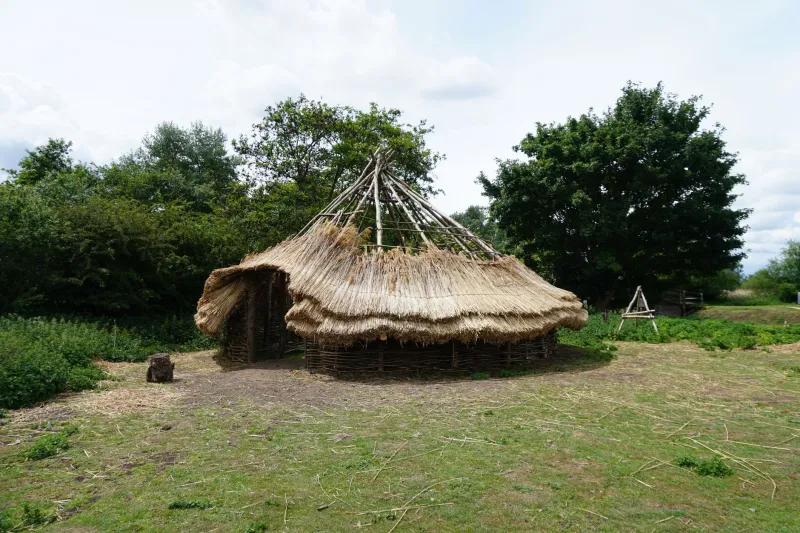
The excavation, carried out in the mid-2010s, revealed a cluster of roundhouses built over a river channel in the Cambridgeshire fens. Because the ground was wet and airless, materials that usually vanish from British archaeology survived: wooden bowls, textiles, charred roof timbers, tools, beads, pottery with food residues still clinging to the inside. The site has been described, fairly, as one of the best-preserved Bronze Age settlements in Britain.
That preservation is the point. Must Farm gives us a rare look at ordinary domestic life in later prehistory — not a king’s grave, not a ceremonial monument, but the messy, practical business of living in a small community on the edge of wetland. It is the ancient equivalent of finding a neighbour’s kitchen mid-argument, except the argument happened in about 850 BC and the kitchen was on stilts.
Why Pompeii is the wrong template
Pompeii was a Roman city engulfed by Vesuvius in AD 79. Its power as an archaeological site comes from sudden burial: streets, shops, frescoes, graffiti, bodies. It offers a catastrophic freeze-frame of urban life in the Roman world. Must Farm offers something different. It is a small rural settlement, not a city; it is Bronze Age Britain, not first-century Italy; and its preservation comes from wetland chemistry as much as from disaster.
The Pompeii label also implies a completeness that archaeology rarely delivers. It suggests we can see Must Farm as a perfect snapshot, every object exactly where a Bronze Age person put it. In reality, the evidence is richer and stranger than that. Objects fell, burned, drifted and decayed. Some things were left behind; others were salvaged or swept away. The waterlogged layers preserve brilliantly, but they do not preserve everything equally.
And there is a quieter problem: calling a British site ‘Britain’s Pompeii’ makes British prehistory sound like a local franchise of a Roman original. Must Farm is not a sequel. It is its own story, with its own date, its own landscape and its own questions.
What the evidence can tell us
Quite a lot, as it happens. The Must Farm finds have given archaeologists evidence for how roundhouses were built, how roofs were constructed, what people ate, how they cooked, what they wore and how they worked wood and fibre. The site has helped push back against the lazy idea that Bronze Age Britain was a grim, muddy backwater. These were skilled people with sophisticated craft knowledge and connections that reached beyond the fens.
The fire itself is part of the evidence. Charred timbers and collapsed structures suggest a serious blaze, and archaeologists have debated what that means. Was it an accident? An attack? A deliberate burning? The honest answer is that the evidence supports discussion, not certainty. That is normal in archaeology. It is also why the Pompeii comparison is so misleading: Pompeii comes with a documented historical event and a volcano. Must Farm comes with silt, charred wood and a set of very good questions.
What it cannot tell us
Must Farm cannot give us a named family, a written account of the fire, or a neat moral about what happened next. No human remains have been found there, so we cannot reconstruct the people themselves in the way Pompeii’s casts encourage us to imagine. We can say a great deal about objects and structures. We cannot say, with confidence, why this particular settlement burned or what the survivors did afterwards.
That is not a failure. It is the limit of the evidence, and it is worth being honest about it. The best archaeology is not the archaeology that pretends to know everything. It is the archaeology that tells you what it has, what it does not have, and how it knows the difference.
A better vocabulary for ancient disaster sites
So what should we call Must Farm? Try ‘waterlogged Bronze Age settlement’, ‘fire-destroyed fenland household’, ‘late Bronze Age time capsule’ or simply ‘one of Britain’s best-preserved prehistoric sites’. None of those will fit neatly on a bus advert. All of them are more accurate.
For 2026 readers, the lesson is simple: be suspicious of ancient disaster branding. ‘Britain’s Pompeii’ is not a scientific description. It is a marketing shortcut, and it flattens two very different places into one convenient headline. Must Farm does not need to be Pompeii. It is already one of the most revealing windows we have into ordinary life in Bronze Age Britain — and that is a better story than a borrowed Roman catastrophe.