Under the Lawn, Under the Tarmac: Why Britain's New-Builds Keep Hitting Roman Villas
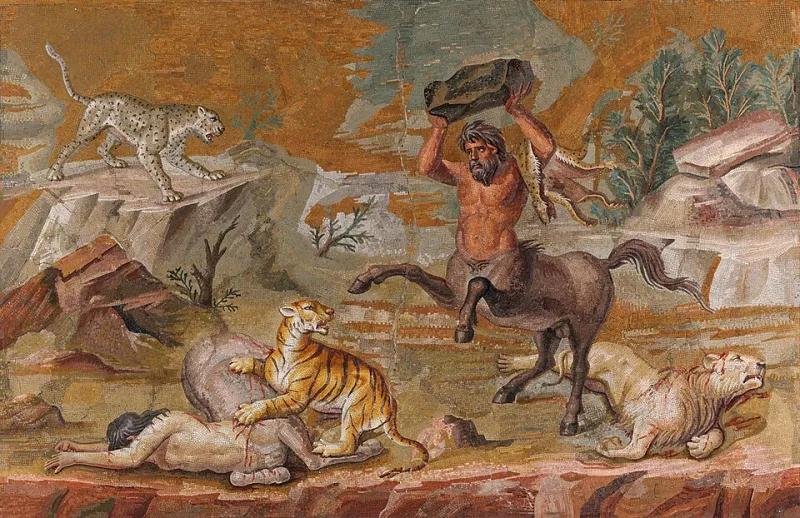
Photo: Unknown Details on Google Art Project, Public domain, via Wikimedia Commons
It has become one of the most dependable rhythms of British archaeology. A developer buys a field on the edge of a market town. Groundworks start. Somewhere between the topsoil strip and the drainage trench, a machine operator spots a band of red tile and pale stone that clearly belongs to nobody's modern building. Within days a county archaeologist is on site. Within weeks the local paper is running a photo of a mosaic that has not felt sunlight since the fourth century.
The Rutland case is the one people still bring up. A fairly ordinary property, a fairly ordinary plan for building work, and underneath it a villa complex with one of the most extraordinary mosaic floors ever found in Britain — a mythological scene, almost certainly showing Achilles — sitting intact beneath centuries of soil and a garden. It made national news for about a week. Then it slipped into the quieter world of planning conditions, conservation decisions and museum storage, which is where most of Roman Britain actually lives.
Why does this keep happening?
Because Britain was, for the best part of four centuries, a heavily farmed and heavily built-up province of the Roman Empire — and because we keep building roughly where they built. Roman villas sat on good agricultural land, near rivers, roads and markets. So do our housing estates. The M4 corridor, the Thames Valley, the Cotswolds, the Vale of York, the chalk of Kent and Hampshire: all dense with villa sites, and all under pressure for new homes.
There is a statistical quirk at work too. Roman Britain was not uniformly wealthy, but the south-east was dotted with hundreds of villas and farmsteads, many abandoned and robbed for stone in later centuries. What survives is often just the foundation trenches and the floors — which is precisely the level a modern excavator reaches first.
As Dr Priya Raman, a senior archaeologist at a commercial unit in the Midlands, puts it: ‘You get a window. It might be three weeks wide before the groundworks contractor needs the land back. Everything you learn has to be learned inside that window.’
The paper trail behind every dig
The reason a housebuilder is paying for archaeologists at all goes back to 1990 and a piece of guidance called PPG16, which first embedded archaeology in the planning system. It was replaced in 2010 by PPS5, and then folded into the National Planning Policy Framework in 2012 — the document that still governs how heritage is treated in England today, alongside equivalent arrangements in Scotland, Wales and Northern Ireland.
The practical mechanics look like this. Before permission is granted, a developer commissions a desk-based assessment and often geophysics. Evaluation trenches follow — usually a small sample of the site, perhaps two to five per cent — to see what is genuinely there. If significant remains turn up, the local authority can attach a condition requiring a written scheme of investigation. Only then does the full excavation happen. And crucially, the developer pays.
‘The good news is that the system catches an enormous amount that would otherwise be lost without a note being taken,’ Raman says. ‘The awkward news is that the system is funded by the people who want the remains gone. Everyone involved knows that.’
Recording something is not the same as saving it
The doctrine that emerged in the 2000s was ‘preservation in situ’ — leave the archaeology where it is, if you can. When remains are exceptional, developers have been required to redesign, drop basement levels, or raise finished floor heights. At the other end of the scale sits ‘preservation by record’: excavation, drawing, photography, sampling, publication, archive. The thing itself is destroyed; the information survives.
Which raises the question the sector tends to answer with a shrug. If a villa is excavated, written up and then built over, have we preserved it?
Tom Ellery, a fieldwork director working across the Thames Valley, is blunt about the trade-off. ‘Nobody in commercial archaeology thinks a housing estate is a museum. But the choice isn't always between a development and a preserved villa. Very often it's between a decent excavation and an unrecorded site being graded flat because it wasn't spotted early enough. The real argument is about resources further downstream.’
That downstream problem is unglamorous and serious: post-excavation analysis, specialist reports and publication backlogs. Digs generate boxes. Boxes generate fees. Fees generate delays. County Historic Environment Records hold the grey literature, but full publication can lag for years, and museum store space is chronically short. HS2's excavation programme — the largest in British history — threw this into sharp relief, with hundreds of sites and an archive mountain to manage.
What actually survives under a driveway
A surprising amount, technically speaking. Deep stratigraphy, foundations and lower floor levels can sit below modern construction, protected by the fact that nobody ever dug that deep. Preservation in situ in a suburban garden is often genuine: the mosaic under a lawn is safer than the mosaic under a plough.
But it is not a guarantee. Services, soakaways, root disturbance, drainage and later remodelling all nibble away. Nor is reburial a permanent answer — a site can be protected by planning condition and then, twenty years on, come up again when someone wants an extension, a conservatory or a car park.
What the Rutland mosaic really demonstrated is how thin the layer is between a nationally significant discovery and a householder's building project. It is one thing to have a planning system that reacts. It is another to have one that notices.
So: preserving, or just delaying the inevitable?
Honestly, it is both, and the balance shifts site by site. Britain's developer-funded archaeology is world-leading in scale and ambition. It has produced extraordinary results — entire landscapes of Roman fields, roads, cemeteries and farms that no research dig could ever have afforded. It has also, undeniably, been a machine for converting archaeology into paperwork ahead of the bulldozers.
Ellery's view is more pragmatic than romantic. ‘People ask if I feel bad about it being built over. Sometimes. But the alternative histories are worse. The one where nobody looks is definitely worse.’
So next time a story pops up about a Roman floor found beneath a new estate, read past the ‘surprise discovery’ framing. The interesting questions are the boring ones: who paid, who recorded it, where the archive went, and whether anyone will ever write it up properly. That is where the past is genuinely either kept or quietly mislaid.