Five 'Ancient British' Stories Tourists Still Pay For — And What the Evidence Actually Says
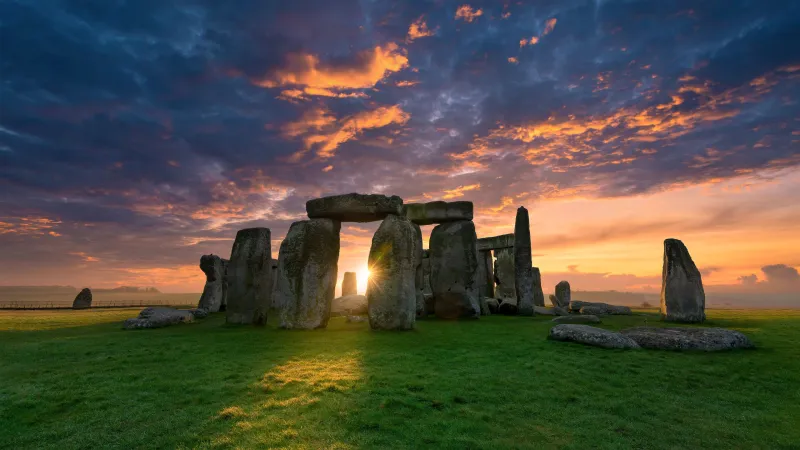
Photo: Stonehenge tourists summer solstice Salisbury Plain, via img.peapix.com
Every heritage shop in Britain sells the same thing alongside the tea towels: a version of the past that is far more fun than the one in the excavation reports. And look, we get it. A druid is better copy than a radiocarbon date. A curse sells postcards. But the real scholarship is usually stranger, messier and frankly more interesting than the legend — so let's line up five of the most persistent myths, and see what the evidence does to them.
Myth 1: The druids built Stonehenge
This is the blockbuster. Coach parties arrive at Salisbury Plain expecting a temple constructed by robed priests with mistletoe and, ideally, a sacrifice.
The problem is a simple matter of dating. The sarsen circle and trilithons went up around 2500 BC; the bluestones arrived centuries earlier. The first written references to druids come from Greek and Roman authors in the last few centuries BC — around two and a half thousand years later. There is no evidence connecting druids to the monument's construction because there were no druids, in any recognisable sense, when it was built.
The druid association is a Georgian invention, popularised by William Stukeley in the 1740s and supercharged by Romanticism. Modern druid orders, who do gather at Stonehenge at the solstice, date from the eighteenth century onwards and are refreshingly open about being a revival rather than a survival.
What the archaeology does show is far better. Stonehenge is part of a ritual landscape built and rebuilt over more than a millennium, aligned on the solstice axis, connected to Durrington Walls and the Avon, and probably used for gatherings of people and of the dead. Nobody needed a druid. It was already extraordinary.
Myth 2: The Sutton Hoo grave came with a curse
Guides love a curse. Mummies have one, Tutankhamun has one, and Sutton Hoo — that seventh-century ship burial under a Suffolk mound — gets given one by association.
There is no curse. There is no inscription, no warning, no ancient imprecation. When Basil Brown and Edith Pretty opened the mound in 1939, what they found was a ship's ghost — the impression of a vessel dissolved in the acidic sand — and a burial chamber stuffed with the most spectacular grave goods in northern Europe: a helmet, a shield, a great gold buckle, coins, silver from Byzantium.
The ‘curse’ narrative is largely a press confection, borrowing the Egyptology template of the 1920s and 1930s. The genuinely eerie thing about Sutton Hoo is the preservation itself: that a 27-metre ship could vanish into the soil and leave only a stain in the sand, still readable by excavators thirteen centuries later.
And the treasure went to the British Museum because Edith Pretty gave it to the nation. Not because anyone was frightened of it.
Myth 3: The Romans never reached Scotland
This one is repeated in pubs from Carlisle to Cardiff, usually by someone who has been to Hadrian's Wall and concluded that the wall is where the map ends.
It is not even close. Agricola campaigned through Scotland in the late 70s and early 80s AD, culminating in the battle at Mons Graupius in about AD 83. A legionary fortress was built at Inchtuthil and then abandoned. The Antonine Wall — turf, stone and ditch, running from the Forth to the Clyde — was built in the 140s AD. Septimius Severus brought an army north in the early third century. Roman finds turn up at Newstead, at Cramond, along the Aberdeenshire coast, and in temporary camps scattered across the Highlands.
What Rome did not manage was a permanent, settled conquest of the north. That is a much more interesting story: occupation as a series of advances, retreats, treaties and costly failures. ‘Never reached Scotland’ flattens a genuinely dramatic frontier into a line on a modern map that didn't exist.
Myth 4: Boudicca is buried under a platform at King's Cross
London's most romantic piece of nonsense: the Iceni queen, defeated in AD 61, lies somewhere beneath the station — sometimes said to be under platform 8, more often 10, occasionally beneath the concourse itself.
We have no idea where Boudicca is buried. Tacitus says she died by poison after the final battle; no source gives a location, and the battlefield itself has never been securely identified. The King's Cross story appears to be a nineteenth-century embellishment, of the sort Victorian London adored, attached to a station that was built on the site of a smallpox hospital and a burial ground — neither of them Iceni.
It endures because it is a wonderful image: a queen under the commuter rush, waiting. But if you want a real Boudicca story, look at the burnt layer. Destruction deposits across Colchester, London and St Albans — the so-called Boudican destruction horizon — are physical evidence of the revolt. That's better than a platform.
Myth 5: The ancient Britons were Celts
This is the myth that hides in plain sight, on tea towels, in tourism brochures and in the phrase ‘Celtic heritage’. The idea is that iron-age Britain was settled by waves of Celtic migrants from central Europe, bringing a distinctive culture, art style and priestly class.
The truth is more tangled. ‘Celtic’ is best understood as a language family, not a biological or ethnic identity. The classical writers who used the word Keltoi were vague and inconsistent about who it described. Archaeology has largely abandoned the old invasion model in favour of continuity — though not simplicity, since ancient DNA work published in recent years has shown substantial migration into Britain during the Late Bronze Age, long before any iron-age ‘Celtic’ arrival.
Modern ‘Celtic’ identity is largely a product of eighteenth- and nineteenth-century romanticism, language revival and, in places, politics. That doesn't make it fake. It makes it modern — which is a different and, we'd argue, more interesting claim.
Why the myths survive
None of this is a scolding. Myths persist because they answer a need: for mystery, for continuity, for the feeling that a place has a story worth paying to hear. The druids at Stonehenge are a better afternoon out than a lecture on post-processualism.
But the real past is more generous than the myths. It has bog bodies and buried ships, destruction horizons and abandoned fortresses, and a Rutland mosaic sitting under a garden for sixteen hundred years. That stuff doesn't need a curse.