Not Curiosities: Britain’s Quiet Rethink on Storing Ancient Skeletons
The box in the basement
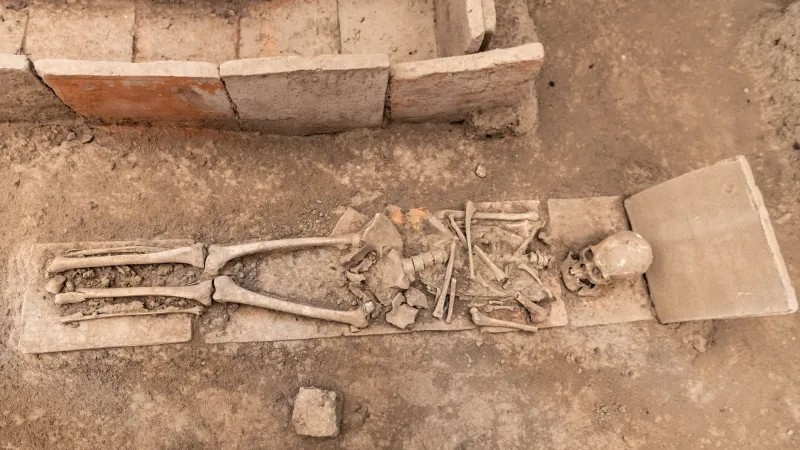
Walk into the storeroom of almost any regional museum in Britain and you’ll find them: long cardboard boxes, acid-free tissue, a careful label. Inside, the dead. A Bronze Age farmer from a barrow in Wiltshire. A Roman Londoner. A medieval child. Most have never been on display. They are, in the language of the sector, “retained”. And for decades, retention has been the default.
That default is now being questioned. Not with placards, but with slow, careful argument in museum committees, academic journals and local council meetings. The question is simple: who gets to keep the dead? And in 2026, the answer is less obvious than it used to be.
A patchwork, not a policy
Britain has no single law that says what should happen to ancient human remains after excavation. Instead, there’s a patchwork. The Human Tissue Act 2004 covers remains under 100 years old. For older skeletons, museums follow guidance from the Department for Culture, Media and Sport — first issued in 2005 and updated since — which allows for reburial in some circumstances, particularly where there’s a strong case from a descendant community or a clear ethical argument.
But guidance isn’t law. And in practice, most museums keep what they excavate. Storage is cheap; disposal is complicated. Reburial requires paperwork, consultation, a decision. Keeping a box on a shelf requires nothing at all.
The case for letting go
The arguments for reburial come from several directions. Modern pagan groups, including Honouring the Ancient Dead and the Pagan Federation, have long argued that ancient remains are ancestors, not artefacts. They don’t claim direct descent; they claim a cultural and spiritual connection. For them, display and storage are a form of disrespect.
Then there are descendant communities — though in Britain, “descendant” is a thorny word. Unlike some settler-colonial contexts, there’s no clear line from ancient skeletons to a specific living group. But some local communities feel a connection to “their” ancient dead. And some archaeologists agree that reburial is sometimes the right call, especially where remains have been fully studied, sampled and recorded.
The practical argument is harder to ignore. Museum stores are full. Space costs money. Not every skeleton needs to be kept forever. “We don’t keep every potsherd,” one curator told me. “Why do we keep every femur?”
The case for keeping
The counter-argument is equally serious. Ancient human remains are a unique scientific resource. New techniques — ancient DNA, stable isotope analysis, radiocarbon dating — have transformed what we can learn from bones. A skeleton that was studied in 1980 might yield entirely new information in 2040. The Cheddar Man, the Amesbury Archer, the occupants of myriad long barrows: their bones are archives.
Museums also argue that they are custodians, not owners. They hold remains on behalf of the public, including future generations. Reburial is, in most cases, irreversible. Once a skeleton is in the ground, it’s gone — scientifically speaking.
What would a UK-wide policy look like?
Campaigners and some archaeologists are calling for a national framework. Not a single law, perhaps, but clearer guidance: a presumption of reburial after study unless there’s a specific reason to retain; a requirement to consult local communities and relevant groups; a time limit on retention; and a national advisory panel to make the tricky calls.
Scotland and Wales have their own heritage bodies and slightly different approaches, which complicates any UK-wide solution. But the conversation is happening. In 2026, the question is no longer whether we should talk about reburial, but how.
The quiet fight
This isn’t a culture war. It’s a slow reckoning. The dead don’t vote. They don’t campaign. But they do take up space — physical, ethical, emotional. And the people who care for them are starting to ask whether the default of permanent storage is really the only option.
Maybe it’s time to let some of them rest.